CG Policy · 2025
In this section7 topics
Corporate Governance Policy
Has a Corporate Governance Policy
Yes
Policy Description
The Board of Directors recognizes the importance of good corporate governance as a fundamental foundation for transparent, accountable, and reliable business operations, and for fostering confidence among all stakeholders. To support sustainable business growth alongside long-term value creation, the Company has established its Corporate Governance Policy in writing, with compliance with applicable laws as a core principle. The policy is further enhanced in line with recognized best practices to ensure that the Company’s operations are transparent, credible, and aligned with the principles of good corporate governance and sustainable development at both national and international levels.
The Corporate Governance Policy applies to the Company’s directors, executives, employees, and all subsidiaries. The Nomination and Compensation Committee is responsible for considering and proposing the policy to the Board for approval with a review at least once a year. Such policy was established in line with the corporate governance principles at the domestic and international levels. Chief among them are Corporate Governance Code for Listed Company 2017 (CG Code) set by the Securities and Exchange Commission (SEC) and the Stock Exchange of Thailand, Corporate Governance Report of Thai Listed Companies (CGR) conducted by the Thai Institute of Directors (IOD), and ASEAN Corporate Governance Scorecard (ACGS).
AIS places strong emphasis on fostering a culture of good corporate governance across all levels of the organization through internal communications, training programs, and the establishment of clear guidelines on key governance matters. These include the prevention of insider trading, management of conflicts of interest, anti-corruption practices, personal data protection, and transparent disclosure. This approach ensures that directors, executives, and employees share a common understanding and are able to comply with such practices appropriately and effectively.
Policy Document Link
https://investor.ais.co.th/storage/document/cg/cg-policy-en.pdf
Page Number in Report
1
Policy & Practices — Board of Directors
Has Policy & Guidelines for the Board
Yes
Board Guidelines
| Guideline | Detail | Document Link | Page Number in Report |
|---|---|---|---|
| Nomination of Directors | The Nomination and Compensation Committee (NCC) is responsible for identifying and selecting individuals with suitable qualifications, with the objective of ensuring that the Board of Directors has an appropriate composition, with the necessary, comprehensive, and diverse skills and experience to effectively support policy formulation and the oversight of the Company’s operations. The criteria and procedures for the nomination and appointment of directors are as follows:
| https://investor.ais.co.th/storage/document/cg/cg-policy-en.pdf | 2-3, 8-9 |
| Determination of Director Remuneration | The Nomination and Remuneration Committee is delegated by the Board of Directors to consider and determine the policy and structure of directors’ remuneration in an appropriate and transparent manner, prior to proposing for approval by the Annual General Meeting of Shareholders. In determining such remuneration, due regard is given to the roles, duties, and responsibilities of directors, compensation levels among companies in the same industry and of comparable size, as well as the Company’s performance, corporate objectives, and the individual performance of each director. The remuneration structure is designed to appropriately reflect accountability, provide suitable incentives, and align with the Company’s long-term performance. | https://investor.ais.co.th/storage/document/cg/cg-policy-en.pdf | 8-9, 12 |
| Independence of the Board of Directors from the Management | AIS maintains a clear separation of roles and responsibilities between the Board of Directors and Management. The Board retains authority over matters that are significant to the Company’s direction and business operations, while Management is responsible for day-to-day operations in accordance with the policies and strategies approved by the Board. The Board also supports constructive working relationships between directors and Management, based on respect for their respective roles and adherence to good corporate governance principles. AIS has established a clear communication structure among the Board of Directors, Management, and shareholders by designating the Company Secretary function as the central point for coordination and support of the Board’s duties. The Internal Audit function serves as the primary channel of coordination between the Audit and Risk Committee and Management to facilitate oversight and follow-up on internal control and risk management matters. The Company also allows directors and Management to communicate and exchange views directly, as appropriate, to promote mutual understanding, support strategic decision-making, and enhance governance effectiveness, while maintaining clarity of roles and professional collaboration for the best interests of the Company and all stakeholders. The segregation of the duties of the Board of Directors and Management The Board of Directors is responsible for setting the Company’s direction, strategy, and key policies, and for overseeing operations to ensure compliance with applicable laws, the Company’s objectives and articles of association, resolutions of shareholders’ meetings, and AIS’s Corporate Governance Policy. In discharging their duties, directors are required to exercise due care, integrity, and reasonableness, acting in the best interests of the Company and its shareholders. Management is responsible for implementing the strategies and objectives established by the Board and for managing the Company’s operations and business effectively. The Chairman of the Board is an independent director and is not authorized to sign on behalf of the Company, thereby reinforcing a clear separation between policy oversight and executive management and supporting an effective system of checks and balances. | https://investor.ais.co.th/storage/document/cg/cg-policy-en.pdf | 3 |
| Director Development | AIS places importance on the continuous development of directors, executives, and the Company Secretary to enhance their knowledge and understanding of their roles and responsibilities, as well as their awareness of legal, regulatory, and evolving business developments. The Company fully supports related training expenses and regularly arranges both external programs and in-house sessions, including briefings by external experts, to provide insights on key topics such as corporate governance, corporate strategy, risk management, and sustainability. 91% of the total number of directors completed the Director Certification Program and/or the Director Accreditation Program (DAP) organized by the Thai Institute of Directors Association (IOD), reflecting the Board’s commitment to good governance and professional standards expected of directors of listed companies. Induction for New Directors The Company provides an induction for newly appointed directors to ensure a comprehensive understanding of the Company’s business, organizational structure, and key operational matters. The session includes performance overviews of each business unit, strategic direction, and key risk factors. Newly appointed directors are also briefed on their roles, fiduciary duties, and responsibilities as directors of a listed company, including relevant laws, regulations, and key policies such as the Company’s securities trading policy and other significant governance policies, to enable them to discharge their duties properly and in accordance with good corporate governance principles. The induction is led by senior management, with relevant materials provided to support effective performance from the outset. | https://investor.ais.co.th/storage/document/cg/cg-policy-th.pdf | 13 |
| Board Performance Evaluation | The Board of Directors has established a policy to conduct a performance evaluation of the Board of Directors and all sub-committees, comprising the Nomination and Compensation Committee, the Sustainable Development Committee, and the Executive Committee. The objectives of the evaluation are to review performance, issues, and challenges encountered during the past year, in order to enhance the effectiveness of the Board, reinforce directors’ awareness of their responsibilities, and foster a constructive working relationship with management. Criteria for Performance Evaluation of Directors The performance evaluation of the Board of Directors and its committees is conducted in two forms: 1) Self-assessment, carried out annually, comprising both individual evaluations and a collective evaluation of the Board and each committee; and 2) External evaluation of the Board of Directors, conducted by an independent external consultant at least once every three years, to provide an objective perspective and ensure alignment with internationally recognized best practices. | https://investor.ais.co.th/storage/document/cg/cg-policy-en.pdf | 12 |
| Corporate Governance of Subsidiaries and Associated Companies | The Board of Directors oversees the operations of subsidiaries and associates as appropriate to safeguard and protect the Company’s investment interests. The Board promotes the adoption of good corporate governance principles across all Group companies and ensures that governance policies in various areas are communicated thoroughly, including business ethics, legal compliance, and anti-corruption, in order to maintain consistent operational standards throughout the Group. The Company has established the following key policies and practices for the supervision of subsidiaries and associates:
|
Policy & Practices — Shareholders and Stakeholders
Has Policy & Guidelines for Shareholders and Stakeholders
Yes
Shareholder & Stakeholder Guidelines
| Guideline | Other — Please Specify | Detail | Document Link | Page Number in Report |
|---|---|---|---|---|
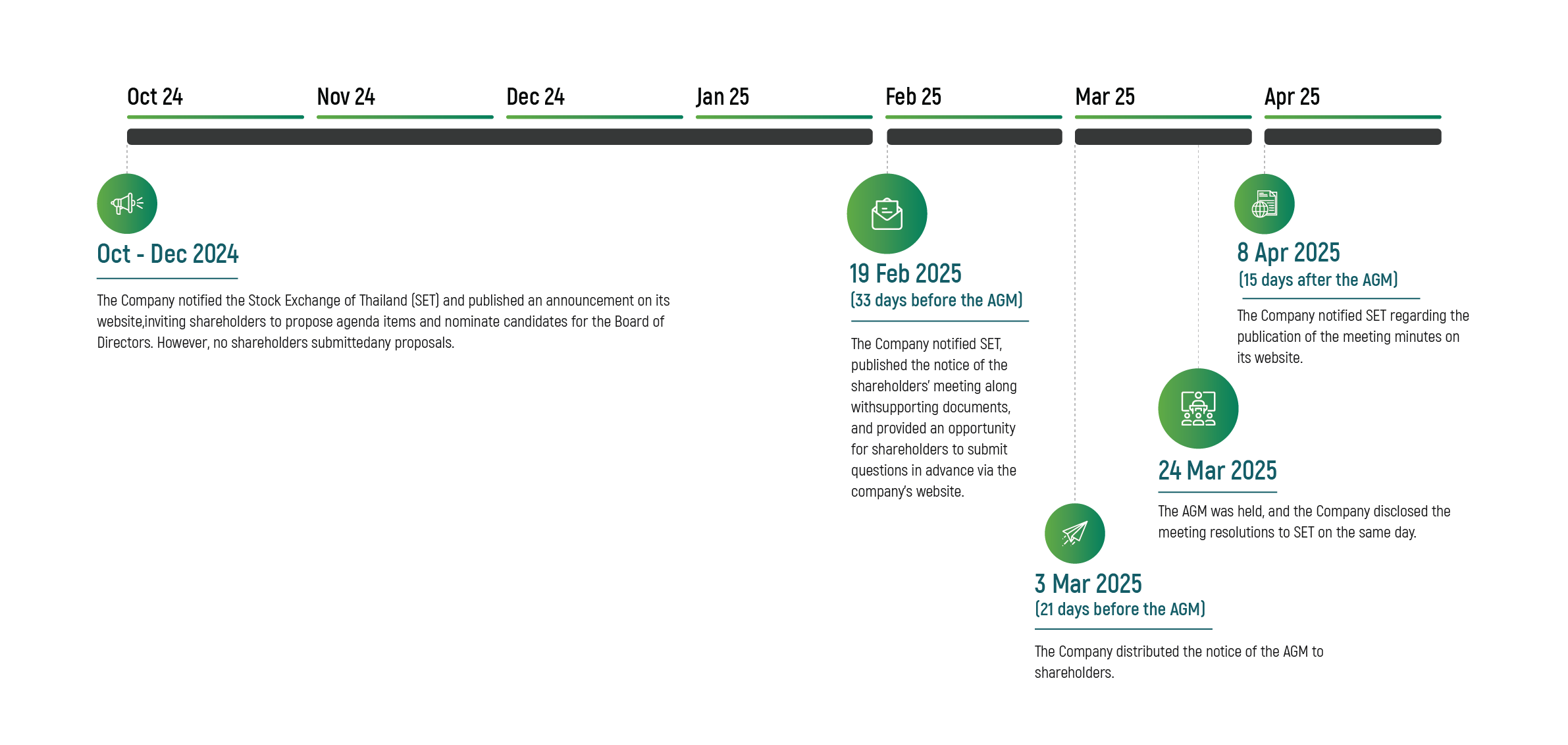
| Shareholder | AIS is committed to upholding the rights and equality of all shareholders, ensuring both their fundamental legal rights and those stipulated in the Company’s regulations. This incl fair and equal dividend distribution, freedom to buy, sell, transfer, or receive securities independently, non-interference in market securities transactions, the right to nominate, appoint, and remove directors, the right to appoint an independent auditor and determine annual audit fees, the ability to propose agenda items for the Annual General Meeting (AGM), the right to express opinions freely during shareholder meetings, and the ability to vote independently on key corporate decisions affecting the company’s operations. Beyond these fundamental rights, AIS actively promotes transparency and shareholder engagement by ensuring the accurate, sufficient, timely, and equitable disclosure of key company information while fostering shareholder participation and confidence through various initiatives as summarized below: Practices in relation to Annual General Meeting of Shareholders (AGM)
AIS conducts its Annual General Meeting of Shareholders in accordance with the principles of transparency, protection of shareholders’ rights, and equal facilitation. The key practices are as follows: Protection of Shareholders’ Rights
Meeting Procedures and Facilitation on the Meeting Day
Conduct of the Meeting
Voting and Vote Counting
Preparation and Disclosure of the Minutes of Meeting
Disclosure of Information and Transparency Practices AIS places importance on the accurate, complete, transparent, and timely disclosure of material information, both financial and non-financial, that may affect investment decisions. Such information is disseminated through the Stock Exchange of Thailand (SET) system and the Company’s website to ensure that shareholders and investors have equal access to information in both Thai and English, without discrimination. The Company’s disclosure policy covers the following principles:
Investor Relations Activities The Company has established an Investor Relations unit to serve as a central communication channel between the Company and its shareholders, investors, analysts, and capital market stakeholders. The function focuses on providing relevant and useful information to support informed investment decisions in accordance with the Investor Relations Code of Conduct. The Company provides both retail and institutional shareholders with opportunities to submit inquiries, offer feedback, and raise matters beneficial to the Company’s operations with Management. In addition, the Company regularly conducts communication activities to provide updates on operating performance, strategy, and business direction. In 2025, the Company conducted the following key investor relations activities:
In addition, the Company conducts an annual collection of investor feedback to support the continuous improvement of its investor relations practices. To prevent the misuse of inside information, the Company observes a one-month silent period prior to each quarterly results announcement, during which it refrains from communicating with analysts and investors. Contact Channels
| https://investor.ais.co.th/storage/document/cg/cg-policy-en.pdf | 13 | |
| Employee | The Company is committed to fostering a positive working culture and environment that promotes teamwork and respects individual differences. Recruitment, appointments, transfers, performance evaluations, and remuneration determinations are conducted based on principles of fairness and equality, taking into account market competitiveness and appropriateness for living standards. The Company places importance on the continuous development of employees through training and learning initiatives, while encouraging constructive employee relations and engagement. The principles of Diversity, Equity, and Inclusion (DEI) are integrated to promote equality, fairness, and respect for individual rights. In addition, the Company is committed to maintaining a safe working environment to safeguard the life and property of employees and to strictly comply with applicable labor laws. The Company respects employee privacy and manages personal data appropriately in accordance with relevant laws and regulations. | https://investor.ais.co.th/storage/document/cg/cg-policy-en.pdf | 17 | |
| Customer | The Company is committed to fostering customer satisfaction and confidence by delivering quality products and services at reasonable prices. The Company discloses information relating to its products and services accurately, completely, and without misrepresentation, in accordance with its Code of Business Ethics. Its management approach encompasses the procurement of standardized products and equipment, quality control of network operations, accurate and transparent billing practices, clear communication of product and service information, and customer care and support through multiple channels, with a view to strengthening relationships and continuously enhancing customer satisfaction. In addition, the Company has established a Personal Data Protection Policy and a Privacy Notice to ensure that customer data is managed appropriately and in compliance with applicable laws. The framework covers data governance and protection, awareness and training for employees and business partners, ongoing monitoring and risk assessment, as well as preparedness measures to prevent and respond to personal data breaches. | https://investor.ais.co.th/storage/document/cg/cg-policy-en.pdf | 17 | |
| Business competitor | The Company supports and promotes free and fair competition, conducting its business in compliance with applicable laws and ethical principles. The Company has no policy of seeking or using competitors’ information through unlawful or unethical means. | https://investor.ais.co.th/storage/document/cg/cg-policy-en.pdf | 18 | |
| Business partner | The Company conducts business with its supplier on the basis of fairness, equality, and mutual benefit. Partner selection is carried out through fair and transparent processes. Business engagements with partners must comply with applicable laws and must not adversely affect the Company’s reputation. The Company recognizes its partners as key collaborators in creating value and delivering positive experiences to customers. In addition, the Company strictly adheres to contractual terms and conditions agreed with its partners. Clear guidelines are established for invoicing and payment processes, with standard payment terms of 30–60 days or as otherwise specified in the relevant contract. Delays in payment may occur only in cases where purchase order conditions are not met or where supporting documentation is incomplete or inaccurate. | https://investor.ais.co.th/storage/document/cg/cg-policy-en.pdf | 18 | |
| Creditor | The Company strictly adheres to its contractual obligations with creditors, ensuring compliance with agreed terms regarding principal repayment, interest, financial terms, and collateral management to maintain financial credibility. It implements effective debt management measures by establishing appropriate repayment plans, monitoring financial commitments, and maintaining transparent and equitable communication with creditors. These efforts reinforce trust and contribute to long-term financial stability. | https://investor.ais.co.th/storage/document/cg/cg-policy-en.pdf | 17 | |
| Government agency | The Company is committed to conducting its business with integrity and transparency, in accordance with good corporate governance principles. The Company declares its intention to oppose the giving or receiving of bribes and all forms of corruption. The Company has no policy of appointing government officials as executives or employees in order to prevent potential conflicts of interest and to maintain neutrality in its business operations. These measures are intended to ensure transparency and to avoid any perception of inappropriate benefit-seeking. | https://investor.ais.co.th/storage/document/cg/anti-bribery-corruption-en.pdf | 8 | |
| Community and society | The company recognizes and prioritizes the community and society. It has established guidelines for managing and fostering positive relationships with the community and society through the following management approaches:
| https://investor.ais.co.th/storage/document/cg/cg-policy-en.pdf | 18 | |
| Other guidelines regarding shareholders and stakeholders | Other Roles and Practices Toward Stakeholders | The Company Secretary’s Office is responsible for overseeing and supporting the Board of Directors in the proper discharge of its duties in accordance with the principles of good corporate governance and in compliance with applicable laws and regulations. The Office collects and forwards matters to the relevant departments, reports to the Management or the Board of Directors for acknowledgment, and communicates the outcomes to relevant stakeholders as appropriate. In cases involving fraud, misconduct, or violations of ethical standards, such matters will be escalated to the investigation process in accordance with the Company’s Whistleblowing, Investigation, and Whistleblower Protection Policy, with appropriate protection measures in place for individuals who report concerns. | https://investor.ais.co.th/storage/document/cg/cg-policy-en.pdf | 14 |
| Other guidelines regarding shareholders and stakeholders | Communication Channels for Stakeholders | AIS provides stakeholders with a communication channel to inquire, provide suggestions, or file complaints regarding various matters directly to the Board of Directors through the following contact details: Company Secretary and Corporate Compliance Office AIS Tower 1, 28th Floor, 414 Phahonyothin Road, Samsen Nai, Phaya Thai, Bangkok 10400, Thailand Email: companysecretary@ais.co.th | https://investor.ais.co.th/storage/document/cg/cg-policy-en.pdf | 14 |
Code of Conduct
Has a Business Code of Conduct
Yes
Code of Conduct Description
To ensure that the Company’s operations and the conduct of personnel at all levels are carried out in compliance with applicable laws, with transparency, integrity, and adherence to ethical principles as the foundation of sustainable business, the Board of Directors has established a “Code of Business Ethics.” The Code comprises 12 categories covering key matters, including responsibilities toward stakeholders, prevention of conflicts of interest, respect for human rights, anti-corruption, and compliance with applicable laws, rules, and regulations. The Company has also established a Business Ethics Committee, chaired by the Chief Executive Officer and comprising senior executives from key functions, to provide direction, drive implementation, and oversee compliance with the Code, while promoting ethical values across the organization. Further details are set out in the Company’s Code of Business Ethics.
Code of Conduct Link
https://investor.ais.co.th/storage/document/cg/cg-policy-en.pdf
Code of Conduct Practices
| Guideline | Detail | Document Link | Page Number in Report |
|---|---|---|---|
| Prevention of Misuse of Inside Information | The Company places strong emphasis on preventing conflicts of interest to ensure that its business operations are conducted transparently and fairly, and in the best interests of the Company and its shareholders. The Company has therefore established policies, rules, and practices applicable to directors, executives, and employees at all levels as follows:
Connected Transaction Policy In order that the business transaction between the company or its subsidiaries and its connected persons shall comply with the laws, announcements, regulation and other relevant notifications from the authorized agency based on transparency and for the maximum benefit of the company, AIS announced the Connected Transaction Policy for the business transaction between the company or its subsidiaries and its connected persons shall be in accordance with the company’s policy, procurement procedure, and Code of Business Ethics. The roles and responsibilities of the Board of Directors, the Audit and Risk Committee, and Capital Market Compliance Section are set to consider the reasonableness of the transaction and to oversee compliance with laws and all departments involving in or acknowledging the occurrence of the connected transactions are required to notify such information to the Capital Market Compliance Department before executing the transaction. The essential part of this policy is that the business transactions between the company or its subsidiaries and its connected persons be done for the ultimate benefit of the company similar to those transactions with external parties under an arm’s length basis. There is procedure to consider before engaging in the connected transactions which the Board of Directors and the executives who are the interested parties or who have conflicts of interest concern shall not participate in the consideration and approval process nor vote in any agenda relating thereto. | https://investor.ais.co.th/storage/document/cg/cg-policy-en.pdf | 19 |
| Anti-corruption | The Company intends to operate its business with a sense of honesty, transparency and in accordance with good corporate governance principles. The Company is also against any type of giving, bribing and corruption by recognizing that giving or bribing and corruption is a serious threat that destroys free and fair competition including causing damage to economic and social development. In this regard, the Board of Directors recognizes the importance and consideration of the Anti-bribery and Corruption Policy for use as a guideline for performing the duties of directors, executives and employees and to comply with the rules and guidelines as well as to prevent the company and directors, executives, employees and other stakeholders from violating the law concerning anti-bribery and corruption. The policy can be found on the Company's website. In addition, AIS has established an approach to battle corruption and has communicated its Anti-Bribery and Corruption Policy to AIS’s subsidiaries, joint venture and other controlling companies, business partners and stakeholders including the public via various communication channels such as email, website, social intranet or inclusion in the Board meeting agenda or reporting part in the annual general meeting every year etc., in this regard, in order to ensure that all stakeholders acknowledged and comply with the guidelines as specified by the Company. Additionally, the Company conducts an annual assessment of knowledge and understanding of business ethics on bribery and corruption. | https://investor.ais.co.th/storage/document/cg/anti-bribery-corruption-en.pdf | 1-11 |
| Whistleblowing and Protection of Whistleblowers | The Company provides channels for both internal and external stakeholders to submit complaints relating to business ethics or to report suspected fraud or misconduct to the Board of Directors. To this end, the Company has implemented the “Fraud and Misconduct Reporting, Investigation, and Whistleblower Protection Policy,” which is publicly available on the Company’s website. The Business Ethics Committee is responsible for communicating this policy to all relevant parties. The policy sets out clear principles and procedures for lodging complaints and reporting misconduct (whistleblowing), as well as measures to protect whistleblowers from retaliation. The Company provides multiple reporting channels for external stakeholders and employees, including a hotline, email to the Chief Audit Executive and the Chief Human Resources Officer, direct email to the Chairman of the Audit and Risk Committee, and written correspondence addressed to the Board of Directors. Upon receipt of a complaint, the Company conducts a preliminary screening process before assigning the matter to the relevant function for investigation in accordance with established policies and procedures. Where there is sufficient basis to proceed, the authorized person will appoint a fact-finding committee to conduct a formal investigation. The investigation results, together with recommended disciplinary actions in accordance with the Company’s work regulations, will be submitted to the authorized person for consideration. Recommendations for process improvements will also be proposed to strengthen internal controls and prevent recurrence. The Internal Audit function reports whistleblowing cases to the Audit and Risk Committee on a regular basis, at least quarterly, and subsequently to the Board of Directors for acknowledgement, thereby ensuring systematic and transparent oversight. | https://investor.ais.co.th/storage/document/cg/whistle-blower-policy-en.pdf | 1-5 |
| Preventing the Misuse of Inside Information | The Board of Directors has established the “Securities Trading Policy for Directors, Executives, and Employees” to maintain the confidence of shareholders and investors in the Company’s securities. The policy prohibits Company personnel from using inside information, whether directly or indirectly, for personal benefit in trading the Company’s securities. The policy is aligned with the Securities and Exchange Act (as amended) and relevant notifications, rules, and guidelines. The Company has prescribed specific obligations for designated persons, including directors, executives, and employees who, by virtue of their positions, have access to inside information. Such designated persons are required to disclose their securities holdings and report any changes in their holdings of the Company’s securities to the compliance function whenever securities are traded or transferred. Designated persons must notify their intention to buy or sell the Company’s securities at least one (1) business day in advance through prescribed channels. In addition, they are prohibited from trading the Company’s securities during the thirty (30) days prior to the disclosure of the Company’s quarterly and annual financial statements (Blackout Period). The Company may also impose a Special Blackout Period in cases where the Company is undertaking material transactions or projects, in order to mitigate the risk of improper use of inside information. | https://investor.ais.co.th/storage/document/cg/securities-trading-policy-en.pdf | |
| Prevention of money laundering | The Company strictly prohibits the acceptance, transfer, or conversion of assets linked to unlawful activities, as well as any actions that facilitate such transactions. This ensures that no one can exploit the Company’s business channels to launder, conceal, or obscure the origins of illegally obtained assets, protecting both the company and its stakeholders from potential harm. | https://investor.ais.co.th/storage/document/cg/cg-policy-en.pdf | 21 |
| Giving or receiving gifts, entertainment, or business entertainment | Directors, executives, and employees should refrain from accepting gifts, whether in the form of items, services, or any other monetary or non-monetary benefits, from business partners or individuals connected to the company for personal gain, either directly or indirectly, unless explicitly permitted by company regulations. While business entertainment may be accepted if it serves a legitimate business purpose, it should be reasonable and appropriate. Directors, executives, and employees should avoid any hospitality that is excessive or could be perceived as improper in maintaining professional relationships with current or potential business partners. | https://investor.ais.co.th/storage/document/cg/cg-policy-en.pdf | 20 |
| Compliance with laws, rules and regulations | Directors, executives, and employees are required to conduct themselves in full compliance with applicable laws, regulations, and internal rules. They must not participate in, facilitate, assist, or knowingly support any acts that violate or circumvent such laws and requirements, whether directly or indirectly. In addition, they are required to fully cooperate with relevant authorities in the event of any investigation or legal proceedings, in order to uphold good corporate governance standards and maintain the credibility of the organization. | https://investor.ais.co.th/storage/document/cg/cg-policy-en.pdf | 21 |
| Use and maintenance of data and assets | Directors, executives, and employees at all levels are responsible for safeguarding and ensuring the proper use of the Company’s assets for the Company’s best interests, including the appropriate control, supervision, and protection of confidential information. The management of confidential information, particularly personal data, must be carried out in accordance with the Company’s Personal Data Protection Policy and applicable laws to prevent unauthorized access, use, disclosure, or alteration. In addition, the Company prepares business records, accounting records, and financial reports with integrity, transparency, accuracy, and completeness, in compliance with applicable laws and generally accepted accounting standards, to ensure that the Company’s financial position and operating results are presented accurately and reliably. | https://investor.ais.co.th/storage/document/cg/cg-policy-en.pdf | 20 |
| Anti-competitive | The Company is committed to supporting and promoting fair and free competition in accordance with ethical business principles and applicable laws. It strictly upholds a policy of non-engagement in any unfair or unethical practices to obtain competitors' information illegally. The Company operates with integrity and fairness, striving to foster a competitive environment that benefits all stakeholders in the market sustainably. | ||
| Cyber security | The Company has established policies and practices to safeguard information security and information systems, with the objective of strengthening employees’ awareness and ensuring compliance with the Company’s policies, standards, operating frameworks, and applicable laws relating to computer systems. These measures aim to prevent unauthorized access, intrusion, theft, destruction, interference, or any other form of cybercrime that may adversely affect the Company’s business operations. Details of the Company’s Cybersecurity Policy and related practices are disclosed on the Company’s website. With respect to internet and social media usage, in light of technological developments that have transformed communication patterns in society, the Business Ethics Committee has approved appropriate guidelines for employees to ensure proper and lawful use of the internet and social media. The core principle of these guidelines is to promote awareness of the potential impacts arising from online activities, whether for personal or professional purposes. Employees are required to exercise due care and avoid conduct that may violate applicable computer laws, including respecting intellectual property rights, verifying the accuracy of information prior to dissemination, and refraining from posting or sharing content that may cause harm to customers or the Company. In addition, the Company conducts an annual assessment of employees’ and relevant parties’ knowledge and understanding of information technology security to continuously strengthen a culture of cybersecurity awareness across the organization. | https://investor.ais.co.th/storage/document/cg/cyber-security-policy-en.pdf | |
| Environmental management | AIS is committed to minimizing environmental impacts arising from its business operations throughout the value chain. The Company has established an Environmental Policy as a guiding framework for environmental management, encompassing climate change mitigation and adaptation, efficient use of resources, promotion of the circular economy, conservation of biodiversity, and comprehensive management of environmental impacts associated with its operations, products, and services. Further details regarding targets, practices, and implementation measures are available in the Company’s Environmental Policy. | https://investor.ais.co.th/storage/document/cg/environmental-policy-en.pdf | |
| Human rights | The Human Rights Policy of AIS and its subsidiaries sets out key principles and practices as follows:
| https://investor.ais.co.th/storage/document/cg/human-rights-policy-en.pdf | |
| Occupational health and safety | The Company has established an occupational health, safety, and workplace environment (OHS) policy to systematically manage and promote safety for employees, contractors, business partners, and surrounding communities. The policy is implemented in compliance with applicable occupational health and safety laws and regulations. To ensure effective implementation, the Company has established dedicated functions and a Safety, Occupational Health, and Work Environment Committee, supported by qualified safety professionals, to oversee risk assessment and mitigation, monitor compliance with safety and environmental requirements, drive policy implementation, report performance results, and recommend continuous improvements. The policy is implemented under the following framework:
| https://investor.ais.co.th/storage/document/cg/code-business-ethics-en.pdf | 5 |
Promoting Compliance with the Code of Conduct
Promotes Compliance by Directors, Executives and Employees
Yes
Description
The Company places strong emphasis on fostering and promoting continuous compliance with its Code of Business Ethics among personnel at all levels in order to support good governance and sustainable business operations. Key initiatives are as follows:
Communication and Awareness Building
The Company communicates its Code of Business Ethics through a variety of online and offline channels, including the internal learning platform (LearnDi), desktop communications, Ethic Clinic, and Nok Weed. Communication materials are developed in accessible and engaging formats, such as cartoons and character-based content, under the concept of “3 Ifs – Risk Prevention,” to reinforce awareness of individual roles and responsibilities in upholding ethical standards in daily operations.
During the past year, 100% of directors, executives, and employees received communication and awareness-building activities relating to the Code of Business Ethics.
In addition, in 2025, the Company reiterated its “No Gift Policy” during the New Year and all festive seasons.
Training and Assessment of Understanding
The Company provides ongoing training on business ethics and anti-bribery and anti-corruption measures through multiple channels, including the new employee orientation program, annual business ethics training, and online learning via LearnDi. These programs aim to ensure that personnel understand the policy intent, practical guidelines, and consequences of non-compliance.
The Business Ethics Committee requires an annual assessment of knowledge and understanding of the Code of Business Ethics and Anti-Corruption Policy, covering employees, business partners, and joint venture companies. The most recent assessment in 2025 was conducted through multiple channels, including online platforms, to facilitate convenient access anytime and anywhere.
The results indicated that 93% of employees, business partners, and joint venture companies were reached through communication, training, or participation in the assessment.
Anti-Corruption Networks & Projects
Introduction
AIS received renewed certification from Thailand’s Private Sector Collective Action Coalition Against Corruption (CAC) on 11 November 2024. The certification is valid for a period of three years from the date of approval. This certification affirms that AIS and its group companies have established and effectively implemented anti-bribery and anti-corruption policies and practices, and that their personnel do not engage in any form of corruption, whether directly or indirectly. The scope of such practices covers key operational processes, including charitable donations and sponsorships, human resource management, and other related activities.
Joined or Declared Intent to Join Anti-Corruption Networks
Yes
Networks & Projects Joined
| Network / Project | CAC Certified |
|---|---|
| Thai Private Sector Collective Action Against Corruption: CAC | Y |
| United Nations Global Compact (UNGC) | |
| Participation of anti-Corruption networks and initiatives |
Material Changes & Developments in CG
Reviewed the CG Policy or Board Charter in the Past Year
Yes
Material Changes or Developments in the Past Year
Yes
Policy Review — Description
Over the past year, the Company has reviewed and improved its corporate governance practices as follows:
1. Amendment to the Code of Business Ethics – Conflict of Interest. In the event that an employee has a family member who is also employed by the Company, such employees must not be under the same line of supervision or be involved in any decision-making processes that may result in granting rewards or imposing penalties on one another.
Employees are required to promptly disclose information regarding such family relationships to the Company in order to prevent any potential conflicts of interest and to ensure that human resource management is conducted in a transparent, fair, and auditable manner.
2. Reviewed the charters of all sub-committees and found that they remain consistent with current practices and the principles of good corporate governance. Accordingly, no amendments were made.
Implements the CG Code for Listed Companies
No
CG Code — Description
The Company considered to apply the Corporate Governance Code (CG Code) issued by the Securities and Exchange Commission, Thailand with AIS’s business operations. However, in 2024 there were certain matters that the Company opted to be considered under other suitable mechanisms and recorded in the minutes of the meeting for regular annual review as follows:
The Company has one independent director who has served more than nine consecutive years. However, the Board of Directors deliberated that the director has the qualification of an independent director and can opine freely in accordance with the related criteria. Moreover, as a special expert, such independent director can support and provide suggestions beneficial to the Company regarding the material risks and adequacy of internal controls.
Other CG Performance & Outcomes
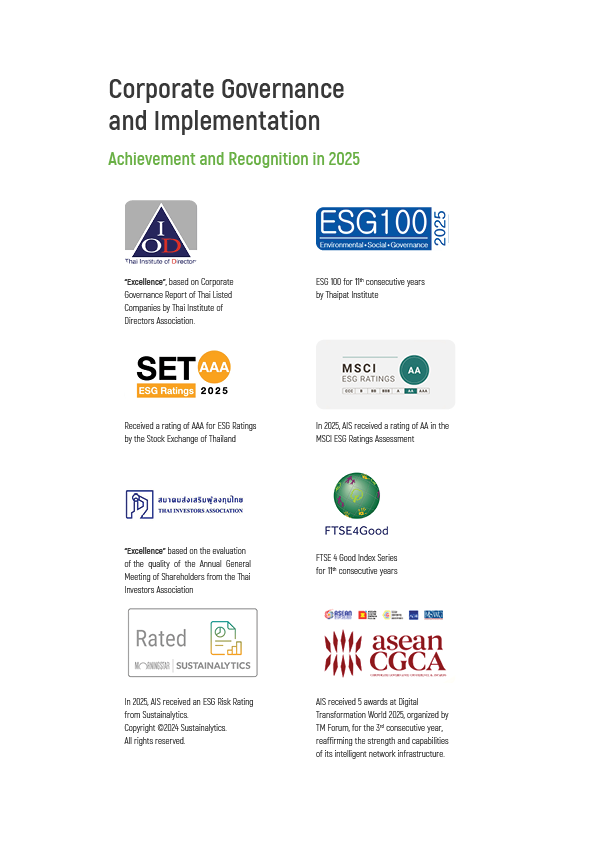
The Company received a "Excellent" (5-star) rating from the Corporate Governance Assessment for Thai Listed Companies, conducted by the Thai Institute of Directors (IOD), and a "Outstanding" rating from the Annual General Meeting (AGM) Quality Assessment Project, organized by the Thai Investors Association, including other assessments as follows: